
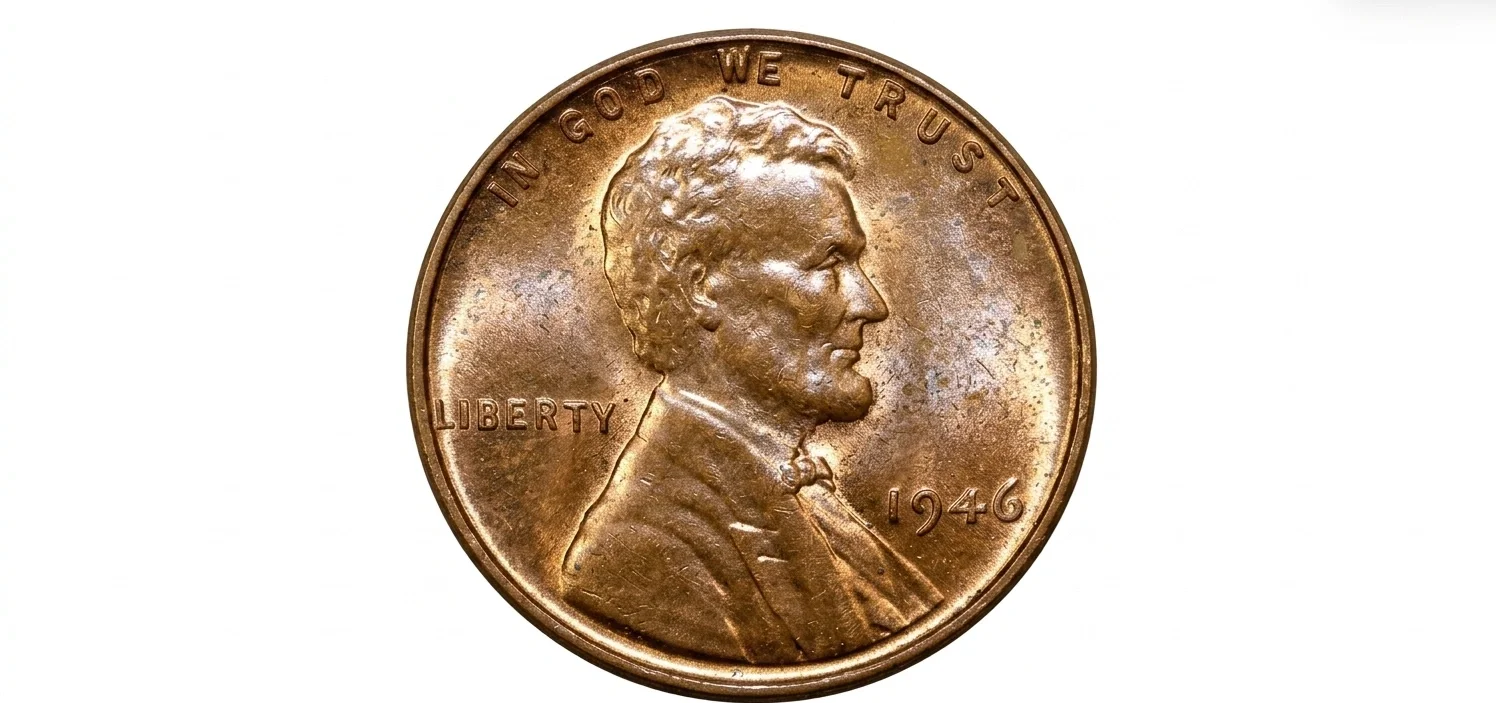
Subtle variations transforming an ordinary 1946 Wheat Penny into a rare find define the complexity of this post-war issue.
Production during this year signaled a return to pre-war metal standards after the military-grade shell casing era ended.
Attribute | Specification |
Metal Content | 95% Copper, 5% Tin, and Zinc |
Mass | 3.11 grams |
Diameter | 19.05 mm |
Edge Type | Plain |
Lead Designer | Victor David Brenner |
Production Figures and Location Codes
Total output reached 1,505,445,269 units, distributed unevenly among the three operating branches.
Identifying the origin of a specific coin depends entirely on the presence or absence of a letter below the date.
Philadelphia → No mint mark → 991,655,000 units
Denver → D mark → 315,690,000 units
San Francisco → S mark → 198,100,000 units
Location marks serve as the primary indicator for determining the scarcity of a particular group.
Industrial Environment of 1946
Transitioning from wartime restrictions to peace-time manufacturing levels impacted overall strike quality.
Heavy workloads prevented the timely replacement of worn-out dies, resulting in numerous minor surface defects.
Double strikes and off-center alignments appeared frequently due to the lack of strict quality oversight during high-speed runs.
Economic expansion required massive quantities of small change, causing rapid wear and tear on heavy equipment.
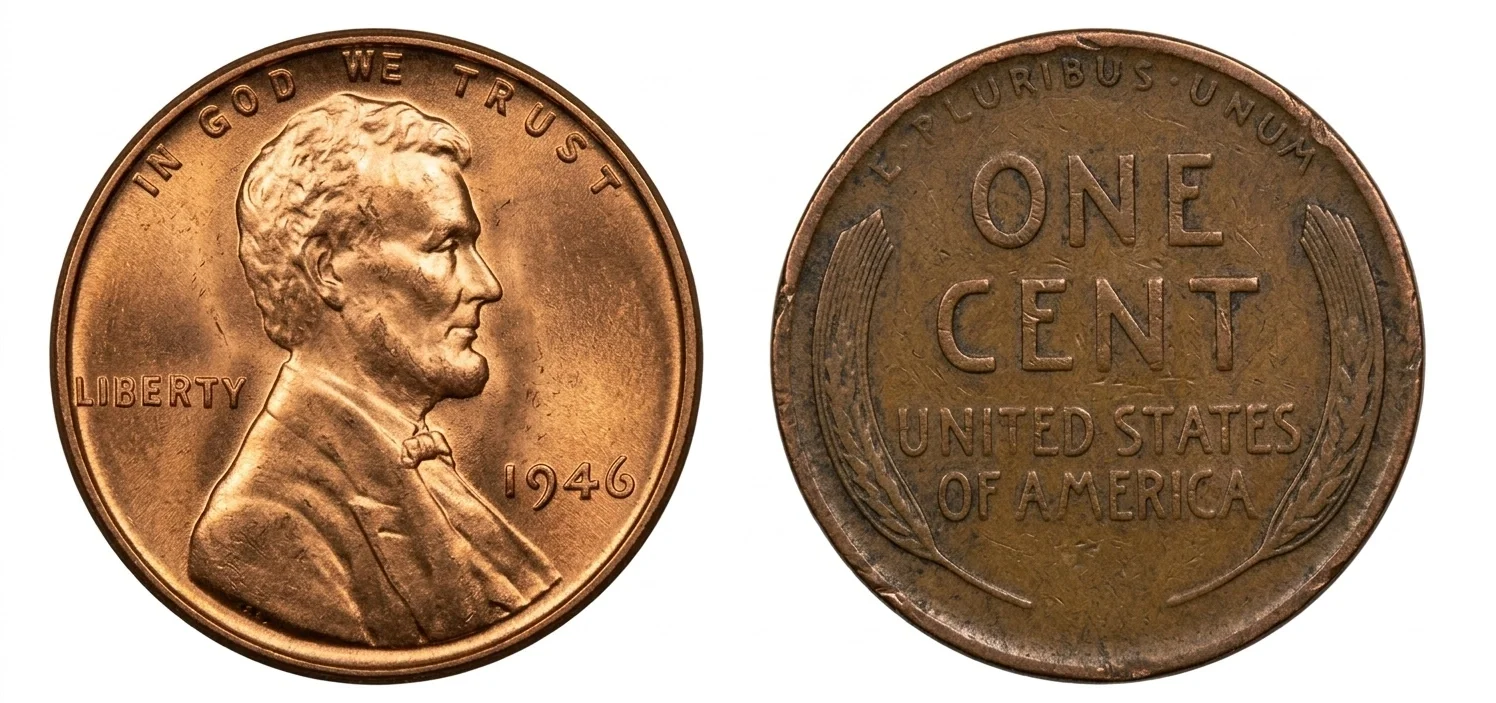
Coins often exhibit blurred details in the wheat stalks on the reverse side because of these mechanical pressures.
Examining Die Varieties and Production Errors
Major numismatic anomalies characterize the 1946 production cycle more than almost any other post-war year.
San Francisco issues draw the most intense scrutiny from specialists investigating letter placement.
Repunched S/S Mint Mark
Entering the letter S onto the die twice with a slight shift created this sought-after variety.
Finding such a defect elevates the market value of the copper piece significantly.
Detection requires high-powered magnification at 10x or the coin scanner app to confirm the overlapping edges.
Directional shifts include:
Northward shift → The top of the S appears doubled upward
Southward shift → The lower loop shows an extra contour line
Horizontal shift → The letter looks wider than a standard strike
D/D Doubled Marks in Denver
Colorado's facility experienced similar technical hiccups during the stamping process.
A doubled D appears less frequently than the San Francisco S, driving high interest among variety hunters.
Value drivers for D/D coins:
Separation clarity → +40% value increase
Surface condition → +30% value increase
Original coloring → +10% value increase
Die scarcity → +20% value increase
2026 Market Analysis and Pricing Trends
Value for a 1946 cent follows the Sheldon grading scale with extreme precision.
Circulated specimens usually fall below the AU 50 threshold in most random discoveries.
Red Gem specimens, appearing as if they just left the mint, remain the highest-performing assets.
Origin | Grade | Market Price | Sale Platform |
Philadelphia (No Mark) | MS 67+ RD | $5,581 | Heritage Auctions |
Denver (D) | MS 67+ RD | $3,360 | Stack's Bowers |
San Francisco (S) | MS 67+ RD | $2,585 | Legend Rare Coins |
Variety S/S | MS 66 RD | $1,250 | Private Collector Sale |
Direct correlation exists between the copper's original color and the final bid amount.
Color classifications used by grading services:
BN (Brown) → Fully oxidized copper → Lowest tier
RB (Red-Brown) → Partially oxidized → Mid-tier
RD (Red) → Original copper luster → Premium tier
Annual appreciation for MS 65 RD units currently averages +4.5% in early 2026.
Top-tier MS 67 coins see growth reaching 12% annually when demand for perfect registry sets remains high.
Condition Grading Benchmarks
Evaluating a 1946 cent requires examining specific high points subject to friction.
Lincoln's cheekbone and the hair above the ear represent the critical focus areas on the front.
Individual grains within the wheat ears and the letters in the word ONE dominate the reverse evaluation.
Grade Level | Surface Description |
Good (G-4) | Outlines are clear but most letters are flat |
Fine (F-12) | Hair details are visible; wheat lines show heavy smoothing |
Extremely Fine (EF-40) | Slight wear on high spots only; some original shine remains |
Mint State (MS-60+) | Zero signs of circulation; original manufacturing luster present |
Deep scratches or signs of cleaning reduce marketability by 60% to 80% instantly.
Damage from harsh environments makes the copper piece undesirable for high-end collections.
Special Characteristics of Philadelphia Strikes
Philadelphia produced the largest volume of wheat cents in history up to that point.
Massive die usage led to significant variability in strike depth across the entire billion-coin run.
"Weak strikes" lacking sharp details frequently occur, often confused with actual wear.
Absence of any letter under the date remains the standard identifier for this location.
Unique errors include coins struck on ten-cent silver blanks intended for different denominations.
These are known as Wrong Planchet Errors.
Estimated 2026 market for planchet errors:
On 10-cent silver disk → $2,000 — $5,000
On foreign currency blanks → $500 — $1,500
Professional Certification Impact
Third-party services like PCGS or NGC provide the industry standard for high-quality copper evaluation.
Processing fees often outweigh the value of common circulated coins.
Decision logic for certification: Original shine exists → Grade likely MS 65 or higher → Submitting is profitable. Surface is brown → Heavy wear is visible → Submitting lacks financial logic.
Certified items sell 2.5 times faster than uncertified counterparts on most platforms.
A sealed plastic holder protects the copper from air-born sulfur, locking the condition for decades.
Identifying Hidden Die Defects
Beyond the standard varieties, mechanical anomalies provide extra value for niche hunters.
Die Cracks appear as raised lines of metal on the coin's surface.
Cracks near the base of Lincoln's bust are specifically common in the 1946 issue.
Lamination Errors occur when the metal layers peel apart before the strike.
These aren't cataloged varieties but attract buyers interested in the manufacturing process.
Cracking Cause → Metal fatigue → Repeated pressure → Hardened steel failure → Double-check with the free coin identifier app
2026 Survival Rate Estimates
Experts estimate that less than 0.5% of the original mintage exists in Mint State today.
Vast quantities of copper were destroyed or melted down during various economic shifts.
Population distribution for certified pieces:
MS 64 and lower → 75%
MS 65 → 18%
MS 66 → 6%
MS 67 and higher → less than 1%
This rarity pyramid explains the massive price gap between an MS 66 and an MS 67 coin.
Small visual differences can result in price discrepancies of several thousand dollars.
Best Practices for Copper Storage in 2026
Copper reacts poorly to humidity and chemicals in the air.
Oxidation turns a bright red coin brown, effectively lowering its market tier.
Storage checklist:
Use PVC-free coin holders
Keep room humidity below 40%
Never touch surfaces with bare skin (use gloves)
Store in dark environments to prevent fading
Following these steps ensures the long-term investment potential of the asset.
Historical Context of the Issue
1946 marked the first full year of peace following the conclusion of global hostilities.
Coins served as symbols of returning economic stability for the American public.
Removing wartime metal restrictions allowed for the return to the classic copper look.
The 1946 Wheat Penny connects the "war copper" era to the classic 1950s production style.
Analyzing this year reveals the sheer industrial capacity of the United States in the mid-20th century.